
Ten Ways DNA Influences Our Relationships
- genetics
- mhc
- attraction

It turns out that romantic chemistry has a lot to do with our DNA.
You know that most physical traits are determined by our DNA, but did you know that DNA can influence our relationships with other people? Here are ten ways our DNA affects the way we interact with other people:
1. Love Is In the Air: Sending and receiving invisible signals with scent
Casanova noted in his memoirs that 'I have always found that the one I was in love with smelled good, and the more copious her sweat the sweeter I found it' The Sweaty T-shirt experiments performed by Professor Claus Wedekind's laboratory demonstrated the scientific basis for "Casanova's sense for Chemistry", showing that opposites do attract genetically, but only at specific genes that encode the receptors for our immune system. Decades of experiments have shown that if a person’s natural body odour smells good then you will share different MHC genes, and you're biologically wired to be attracted to that person for a relationship or friendship. People who find each other's scent to smell awful are likely to share similar MHC genes and are unlikely to experience the feeling of “chemistry” in person. Sensing an unpleasant body odour is your natural warning signal to detect genetic incompatibility!
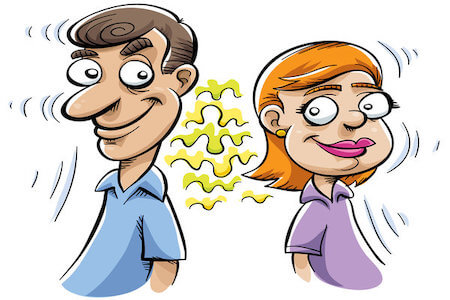
2. Humans Invented Kissing To Test For Genetic Compatibility
Our sense of smell detects molecular cues carrying information about genetic relationship and individuality. If we like the smell of someone then our biological instincts are activated, resulting in changes in our mood and social behaviour. During courtship the act of kissing allows us to get close enough to smell each other's natural body scent (Wlodarski and Dunbar., 2015).
3. Our 2nd Date Preference Is Influenced By DNA Compatibility
A recent study in an Asian American population has found the MHC-based attraction AKA "Romantic Chemistry" is just as important as personality in predicting second date offers (Wu et al., 2018).

4. Orgasm Strength and Frequency Is Influenced By Genetic Compatibility
Males perceived to have a pleasant scent by their partners have been shown to induced higher female orgasm intensity and frequency (Sherlock et al., 2016).

5. The Ability To Sense 'Chemistry' With Someone
The pull toward partners with dissimilar MHC genes carries into long-term relationships. Kromer et al., 2016 found associations between HLA dissimilarity and sexual satisfaction in established couples. The science summary lists this and related research.
6. Genetic Incompatibility Could Influence Affairs
It's difficult to study this phenomenon in humans due to ethics, but genetic incompatibility has been observed by following the lives of the obligate pair-living fat-tailed dwarf lemur which maintains life-long pair bonds but has an extremely high rate of extra-pair paternity. Schwensow et al., 2008 found that extra-pair mating in dwarf lemurs occurred when couples shared a significantly higher number of MHC-supertypes with their partners, and that the cheating partner would find an extra-pair mate with very different MHC, relative to their life partners.

7. The Same Rules For Genetic Compatibility Influences Our Choice Of Friends
A study testing more than one million DNA data points in a population of 1,367 friendship pairs and 1,196,429 stranger pairs found that friendships were more likely to be between people most different at a few gene sets encoding the olfactory and immune system functions (Christakis and Fowler., 2014).

8. Family Planning
Researchers have also studied whether couples who share immune genes, the HLA alleles within the MHC, differ in pregnancy outcomes. Ober et al., 1998 followed Hutterite couples for ten years and reported more pregnancy loss among couples who matched across the 16-locus haplotype they examined. Mora-Sánchez et al., 2019 proposed a model that uses couples' HLA haplotypes to estimate the likelihood of recurrent miscarriage. DNA Romance does not test for pregnancy outcomes, and its compatibility rating is not a fertility or miscarriage measure. The science summary lists these papers with short notes on each.
9. The Head Turner: We are wired with the instincts to help select the right partner for us!
Is that just a great perfume or colone? or did your head just turn for your one in a million match? Milinski and Wedekind., 2001 performed experiments that showed evidence for MHC-correlated perfume preference in humans, demonstrating that perfumes do in-fact amplify ones natural body odours corresponding to their immunogenetics. These results can help to explain why the same perfume smells differently, on different individuals.

10. You Can Use DNA Matchmaking To Help Improve Your Online Dating Experience and Find Your Life Partner Sooner
Online dating has dramatically changed the way we meet people, connecting us across different social circles and geographies but, you can't use all of your senses online. DNA Romance use understandings in the science of genomics and evolutionary biology to match single people with other's who are most likely to jive with them. Our DNA matchmaking algorithm, guides our users by showing MHC "dissimilar" individuals to have high compatibility ratings, a forecast of expected sexual chemistry between these individuals.

Related articles
Romantic Attraction and Finding Your Perfect Match
Have you ever wondered how DNA dating can help you find true love? Read the inspiring story of a couple who used DNA analysis to confirm their love and ultimately tie the knot. Could you be next?
The Genes For Love
Genes inside the Major Histocompatibility Complex (MHC) shape immune function and partner choice. Diversity in MHC is what your body is searching for when scent guides attraction.
The Genetic Foundations of Romance: Understanding the Science of Human Attraction
The Genetic Foundations of Romance: Understanding the Science of Human Attraction